5 Signs for Dancers Healing from Diet Culture
For dancers moving away from restrictive eating, the goal is usually the same: to eat in a way that feels normal: less pre-planned, less governed by rules, and more in tune with what your body actually needs.
I’ve written before about the role of flexible meal planning for dancers. Whether or not a history of disordered eating exists, flexible meal plans ensure adequate nourishment throughout a long, demanding dance day. But the real destination is learning to loosen the reins at mealtimes, and intuitive eating is one of the most useful practices for getting there, especially for dancers healing from disordered eating, chronic dieting, or moving through eating disorder recovery.
One important caveat first: loosening the reins is not the same as a “carefree” approach to eating, a technique I don’t recommend for dancers, and for good reason. The piece of the intuitive eating paradigm that most often gets lost in translation is the ongoing need for adequate nourishment. Even for dancers who aren’t struggling with disordered eating, flexible meal planning remains a valuable tool for supporting practical hunger.
Transitioning away from meal-plan reliance opens space for a more intuitive approach to food. As a Registered Dietitian, this is a shift I introduce in the later stages of eating disorder recovery, only after a dancer has made meaningful strides in healing their relationship with food.
What Does It Mean to Heal Your Relationship with Food?
A supportive relationship with food looks different for everyone. Generally, though, it allows food to nourish your body in a way that feels neutral and pleasurable, while honoring the options that are realistically accessible to you. Nutrition can absolutely be part of this picture, but only when it’s used in a way that doesn’t feel overwhelming or obsessive.
I’ve previously shared how dancers can gradually shift their perspective to build a supportive relationship with food. It takes consistent, proactive effort to challenge diet-culture messaging, with the goal of prioritizing your own preferences and satisfaction rather than external calorie counts or food rules.
A few hallmarks of a supportive relationship with food include:
- Identifying and honoring comfortable levels of hunger and fullness throughout your day
- Honoring your hunger without self-doubt
- A compassionate lens that helps you understand the reasons behind behaviors often labeled “bad” or “destructive” (such as emotional eating, mindless eating, and “over” eating)
- Trusting yourself around foods you may consider more indulgent
- Allowing flexibility in how, what, and when you eat
Is Intuitive Eating Right for You?
Intuitive eating involves rejecting the dieting mentality, building awareness of internal cues like hunger, fullness, and satisfaction, challenging unattainable body beliefs, granting yourself unconditional permission to eat without guilt, and learning to fold in nutrition science and joyful movement without slipping into obsessive behavior.
But for dancers, intuitive eating cannot be the first and only step toward a supportive relationship with food.
For some dancers, it can take years before an intuitive approach becomes genuinely helpful. In fact, while I’m a certified Intuitive Eating counselor, only a portion of its principles appear within The Healthy Dancer®. Of the ten principles of Intuitive Eating, two are nearly impossible to apply in the early stages of recovery: “Honor your hunger” and “Feel your fullness.” A busy, physically active lifestyle disrupts a dancer’s ability to read hunger and fullness cues reliably, and a history of restrictive eating, whether intentional or unintentional, only deepens that disconnect.
Am I Ready to Eat Intuitively? 5 Signs to Look For
Not every dancer will be ready for this stage of recovery, because an intuitive approach is only appropriate after you’ve unraveled much of what diet culture has set in motion. Working alongside a Registered Dietitian Nutritionist is strongly encouraged.
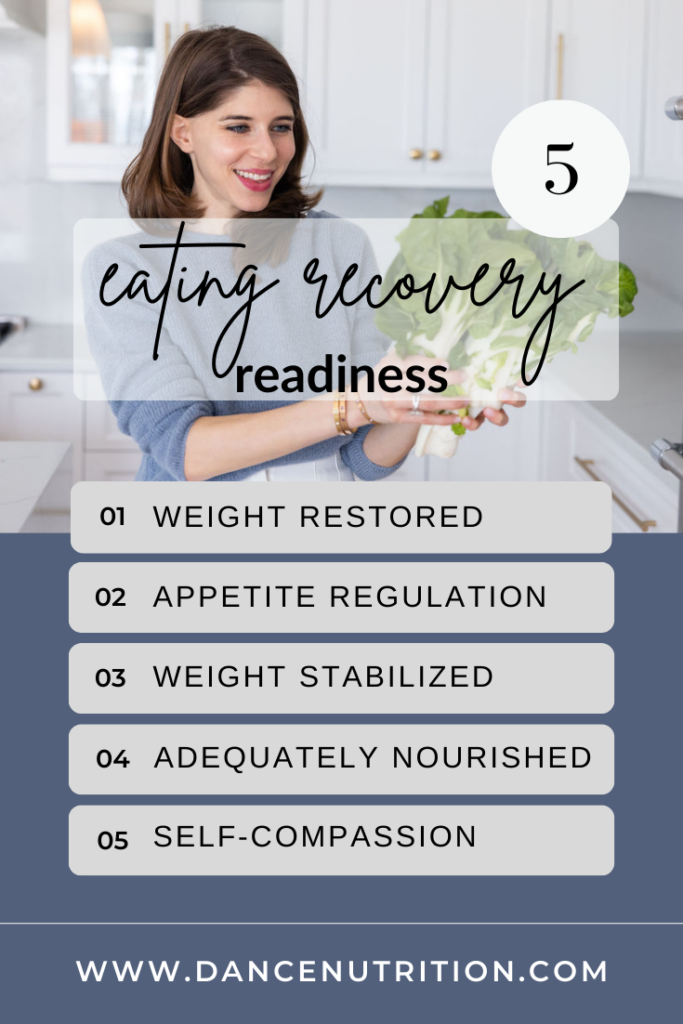
To gauge whether you’re ready, see how many of these five truths apply to you.
#1: You Are Not Actively Restoring Your Weight
Weight restoration is a specific term in eating disorder recovery. When supporting a dancer through it, we’re working toward a set-point range that meets the body’s physical and metabolic needs, and toward stability in that range over time. It’s often the first and most important step in recovery, and one I always encourage dancers to pursue with professional support from a licensed dietitian and a mental health provider.
If you’re still actively in this phase, intuitive eating likely isn’t the next step yet, and that’s completely okay.
#2: Your Appetite Has Begun to Regulate
As you heal, it’s common to experience extremes in hunger and fullness. Many dancers find themselves eating past the point of physical comfort in the early stages of recovery, while others find that even small amounts of food feel uncomfortable. The sensation of fullness can feel new and sometimes frightening. This is a normal part of the process.
As your appetite regulates, you become better able to recognize comfortable levels of hunger and fullness. That takes time, and it often means gently unraveling long-held beliefs about portion sizes along the way.
#3: You’re No Longer Trying to Micromanage Your Body
One of the more challenging steps in recovery is re-evaluating body ideals. For some dancers, this extends to re-evaluating their environment: seeking out a studio or company that celebrates body diversity and steers clear of weight checks. (Yes, these sadly still happen in the dance world.)
#4: You’re Committed to Prioritizing Adequate Nourishment
By this stage, you should feel familiar with tools like food flexibility and food neutrality, both core components of The Healthy Dancer®. Food flexibility allows for spontaneous eating experiences that don’t stress you out, even when they involve foods you’d previously deemed off-limits.
This commitment is what keeps intuitive eating grounded, rather than letting it drift into the “carefree” territory that can quietly undermine recovery.
#5: You’ve Replaced Self-Ridicule with Self-Compassion
Behaviors often perceived as “bad,” such as emotional eating, mindless eating, and “over” eating, may still come and go, even once you’ve healed from disordered eating. Rather than treating them as “setbacks,” it helps to acknowledge a simple human truth: we all seek comfort during times of discomfort.
To protect your hard-won relationship with food, it’s worth sustaining a supportive team around you, which may include ongoing check-ins with your dietitian and mental health provider. A few articles to support you here:
A Final Note
There’s no timeline you’re supposed to hit. Intuitive eating is a destination you arrive at once your body and mind are ready, not a test you pass or fail. If you recognized yourself in only one or two of these signs, that isn’t a shortcoming; it’s information about where to focus next.
If you’re navigating disordered eating and want support, please consider working with a Registered Dietitian and a mental health professional who specializes in eating disorders. You don’t have to figure this out alone.
Looking for individualized guidance? Learn more about working together inside The Healthy Dancer®.